Showing posts with label outlining. Show all posts

Monday, April 29, 2019

FEAR THE STARS cork board

For my last few novels I've taken to writing a summary of each chapter on 3x5 notecards and laying them out on the ground or on a cork board. The following is what I did for Fear the Stars while I was going through the final revision a few months ago (smudgified to prevent spoilers):


I also use Scrivener as my writing software, and Scrivener has a cork board feature which I use extensively. That said, there's something about physically seeing all of my chapters and scenes in order, and being able to move them around in a physical space, that I find very helpful.

Fear the Stars comes out in about seven weeks! I've already started getting my advanced copies from my publisher, and I have to say I'm very excited about this book. I realize I say that every time, but I honestly think it's because of a positive trend in my novel-writing abilities as opposed to any bias on my part (I mean, let's be clear, there's that, too, but still).

If I were to rank my Chaos Queen novels, I actually think Duskfall and Dark Immolation are about on the same level. They're very different novels, with very different strengths and weaknesses, but if I had to grade them on a whole I'd say they're of roughly the same quality (which is, in my opinion, pretty good quality). I think Blood Requiem, on the other hand, is clearly superior to the first two novels in the series. It's tighter, the characterization and character voices are stronger, and overall the writing is just better.

I think Fear the Stars is to Blood Requiem what Blood Requiem was to the first two books in the series: tighter, stronger, better. That's a good thing for a number of reasons, but mainly in that I think it's displaying how I'm generally getting a better grasp on what it means to be a writer. That's a trend I hope continues throughout my career.

As far as Dawnrise goes, it definitely has the potential to be my best book yet. It might end up being more or less on par with Fear the Stars, or, perhaps, just a smidge lower (I really did like FtS, ya'll). Only time will tell, of course, but based on my outline and what I've written so far, I'm feeling very confident about the ending book of the series.

Monday, April 15, 2019

Retreat to the House on the Hill V

Once again, I head the pleasure of attending the now annual Retreat to the House on the Hill. This was my fifth time attending the writing retreat, and incidentally the fifth time the retreat has been held--so I've been around since the beginning. It's a fantastic opportunity to get a ton of writing done, as well as get to know some other writers.

Dave Butler, author of the Witchy War series among many other books--and my touring teammate--continues to serve as gracious host of the retreat. I spent time with many other talented and awesome writers while there as well--and I'm particularly proud of the work I accomplished while there. For me, it went more or less like this:

Monday: Outlining Dawnrise, the fifth and final books of the Chaos Queen Quintet.

Tuesday: Finished the DR outline. (I'd hoped to be finished by the outline before the retreat, but alas, that did not happen. And, tbh, I'd started getting a bet down on myself on Tuesday because, while I was accomplishing a lot of work by finishing the outline, I wasn't getting tangible words written, and that bothered me. [To be clear, I don't think it should have bothered me--work is work, and writers get things done in all kinds of ways--but I find retreats are at their most useful for me at the drafting phase, where I can just churn out a lot of words. So, I was letting that get to me.]) But, once finished with the outline, I did start writing the Prologue of DR, getting a whole 255 words into it :-D.

Wednesday: Continued the first draft of DR in earnest, writing 8494 words.

Thursday: 9013 words farther into the DR draft.

Friday: 10066 words! It's a rare occasion that I get 10,000 plus words (I think I can count them on one hand), and this was one of those days. Killed it.

Saturday: 4206 words. This was more of a half day, but 4200 is still much better than my daily minimum goal (2k).

So, all things considered, I wrote just over 32,000 words for the week. That's more writing than I do in a month, sometimes, so I'm pretty happy about it. And, despite heavy outlining at the beginning of the week, I'm very happy I was able to dig into a decent word count total at the end. I think that puts me at just over 20% as far as my progress on Dawnrise goes, and that feels pretty good.

Oh, also I won the Edward M. Kovel award for "Best-coordinated loungewear on a Curmudgeon." That was the exact Kovel award I was gunning for, tbh, so I couldn't be happier there, either!

Tuesday, March 10, 2015

Story Structure Round-Up

So, a little less than a year ago I did a series of blog posts on story structure, examining a few different archetypes. I only recently (um...) wrapped that series up, so I figured now would be as good a time as any to give you a round-up of those posts, so you can see them all in one place. So, here you go! If you're interested in outlining, the Hero's Journey, Joseph Campbell, story structure, Dan Harmon, feminism, or especially all of the above, then you should check out the following:

1. Dan Harmon's Story Structure (my personal favorite of all the structures I've examined)
2. Joseph Campbell and the Hero's Journey
3. Kim Hudson and the Virgin's Promise (Part I)
4. The Virgin's Promise (Part II)
5. Stephen King's Writing Advice (a review of On Writing)
6. Analyzing Frozen using The Virgin's Promise and The Hero's Journey

While I'm sure this won't be the end of what I have to say about story structure, I think it makes a pretty good start.

Friday, February 27, 2015

FROZEN (and the Virgin's Promise)

I know it's been a while, but I've been meaning to examine the structure of the Disney film Frozen within the framework of the Virgin's Promise (an altered version of the hero's journey I discussed...um, almost a year ago...yikes!). So, without further ado...

~

Frozen is an interesting film in that it has two central protagonists: Elsa and Anna. Both sisters have
their own arc and journey. At first, I assumed Elsa's arc would resemble the Hero's Journey, while Anna's might be closer to the Virgin's Promise. For some reason Elsa seems a more active, perhaps even a more masculine character (there's gender bias at work, folks), so I figured hers would be the Hero's Journey. But when I tried to hash it out that way, I just couldn't make it work. I then tried fitting both of their arcs into the Virgin's Promise, but it still didn't gel--Elsa and Anna's stories are just too different. Finally, I found something that worked: Elsa's arc as the Virgin's Promise, while Anna's as the Hero's Journey.

Let's look at Elsa's arc first. Oh, and in case you're wondering, yes, spoilers follow.* (But if you haven't seen Frozen by now, I can't imagine you actually care.)

ELSA

Elsa's Dependent World mainly consists of Arundel and her parents; she is dependent upon them for material survival, of course, and for protection. But she also depends heavily on social convention (apparently people with crazy elemental powers are frowned upon). She also craves love and acceptance, and she depends upon Arundel for that love and acceptance. And, later, she is dependent on the imposed security measure of "conceal, don't feel."

Price of Conformity: The first three segments of the Virgin's Promise are sort of all thrown at us within the first five minutes of the movie, and kind of in jumbled order. Elsa has two major prices to conformity: the first that, as a princess, she naturally lives with restricted boundaries, but the second and far more important happens after the incident while she and Anna are playing: Elsa must conceal, not use her power, and she must spend time isolated and away from her sister.

Opportunity to Shine: This happens when Anna and Elsa wake up early and Elsa uses her magic as they play together. Elsa is using her magic for good, she is bringing joy to her sister, and the moment is pure and genuine until Anna is hurt in the process.

Dresses the Part: Elsa fully realizes the meaning of "conceal, don't feel"--she completely isolates herself from her sister and her Arundel. She is doing what she thinks she needs to do, what her parents have instructed her to do in order to stay attached to her dependent world. But, of course, she is not happy doing it.

Secret World: Elsa attempts to please everyone--her parents by hiding her power, her kingdom by playing the part of future Queen, etc.--except herself.

No Longer Fits Her World:  After the coronation, when Anna asks Elsa's permission to marry, Elsa can no longer contain her power; she literally can no longer fit in the world she has been trying to make for herself, and she is Caught Shining--her power is revealed for the whole Kingdom to see.

Finally, Elsa Gives Up What Kept Her Stuck in the iconic song "Let it go."


But both of her Kingdoms are now in Chaos: her old Kingdom of Arundel is suffering a crisis of succession and wondering what on earth happened to it's Queen, and later her new ice kingdom comes under attack by Hans' men.

When Elsa fatally wounds Anna, she Wanders in the Wilderness. This is her moment of doubt, where she wonders whether all the changing she is going through is worth it.

Chooses Her Light: This segment is embodied by two moments: first, when Elsa escapes the prison in which Hans placed her, knowing she can no longer continue to use her power and remain in her old kingdom--her dependent world--as she knew it. And second, later, when Elsa realizes she can use another form of her power--love--to save Anna.

Re-Ordering/Rescue: Anna saves Elsa from Hans, while the other Lords watch from the balcony. Elsa is rescued from without and reconnected in a positive way to her kingdom as the Lords watch her heal Anna.

Kingdom is Brighter: The people of Arundel realize that Elsa is a better person--and ruler--when she embraces her power, and Elsa finally finds her place, both with her magic and ruling her kingdom, as she and everyone she loves skate around on the little ice rink she has created.

Fits in pretty well with the Virgin's Promise, if you ask me! Of course there are some slight deviations in the order of things, and the arc is certainly open for interpretation, but that's the way all stories should be--none should fit into the premise perfectly.

~

Now, let's look at Anna's Hero's Journey.

ANNA

Anna's story begins a bit later than Elsa's: her Ordinary World is basically described in the song "Do  You Want to Build a Snowman?" She lives a somewhat lonely life in her family's castle, isolated from her sister and the rest of the kingdom.

Anna has a few different Calls to Adventure. In the first rendition of "For the First Time in Forever" the castle doors are opening and she'll get to interact with real, live people. That's a call in and of itself--Anna is given a reason to change something. Another call happens when she meets Hans and he proposes to her. Perhaps her most important call is when Elsa's public use of magic causes her to flee, and Anna is faced with the decision of what to do next. (This use of magic could also be deemed a Supernatural Aid that get's Anna out the door and on her adventure.)

When Anna leaves her castle and ventures out into the now-wintery kingdom to find her sister, she Crosses the Threshold.

Anna's Road of Trials consists of finding winter clothing, meeting Kristoff, fighting off the wolves, meeting Olav, and hiking to Elsa's palace. These conflicts and meetings are what begin to forge Anna into the hero she needs to be by the end of the story.

Anna's Meeting with the Goddess occurs when she finally reaches Elsa, with the reprise of "For the First Time in Forever." This could also be deemed a version of Atonement with Father when Elsa reacts the way she does, and one of her shards pierces Anna's heart. (Other versions of Atonement with Father in Anna's journey could be her meeting with the troll rock people thingies, or when she finally reunites with Hans only to discover he does not love her after all and has betrayed her and her sister. Incidentally, those encounters could also fall into a "Part 2" of the Road of Trials--see what I mean when I say this is fluid?)


Anna's Apotheosis occurs a bit later, when she manages to save Elsa from Hans' sword, sacrificing her own life. Her Ultimate Boon, in turn, is the "true love's kiss" she receives from Elsa that saves her (this could also be deemed her Rescue from Without).

Finally, Anna Crosses the Return Threshold when she returns to her Kingdom, having changed her perspective on the world, love, and life in general. She is now the Master of Two Worlds with the Freedom to Live as she sees fit. She and Kristoff, of course, get together, Anna is reconciled with Elsa, and they all live happily ever after.

~

Frozen really is a great film, and it's protagonists fit the Hero's Journey and Virgin's Promise story structures in clear, but interesting, ways. Not only that, but the film does a great job of weaving the two arcs with one another, allowing significant parts of one major arc to compliment and sometimes juxtapose with significant parts of the other arc (a topic for another day, perhaps). Anyway. This stuff is kind of fun to think about, and hopefully it helps you understand what I'm talking about when I talk about story structure.**


* I highly recommend you read my previous articles about the Virgin's Promise and the Hero's Journey as context to this examination. It'll help a lot, I think. So, here's some links!
The Hero's Journey
The Virgin's Promise Part 1


** In fact, I've been thinking about the recent film Interstellar and how Matthew McConnaughey's character arc is actually closer to the Virgin's Promise structure than it is to the hero's journey. Something I may go into more detail later.

Monday, April 28, 2014

The Virgin's Promise (Part 1)

I mentioned when I crash-coursed through the Hero's Journey that there were some bits I didn't entirely appreciate--mainly the stark lack of female perspective in the Hero's Journey cycle. Now, to be clear, that doesn't mean that women cannot experience the Hero's Journey, or that there aren't thousands of countless "Heroine's Journeys" out there, because there certainly are. But the Hero's Journey itself has an inherently masculine structure and terminology (and to be quite honest, Campbell's Hero with a Thousand Faces got a little too misogynistic for my tastes at times). Well, I researched feminine perspectives on the Hero's Journey, and finally found a book that captures what I was looking for: Kim Hudson's The Virgin's Promise* (hereafter referred to as TVP).

Why a Feminine Perspective?

Christopher Vogler, who wrote The Writer's Journey (which is essentially a "Campbell for Dummies Writers"), also wrote the foreword to TVP. While he considers the Hero's Journey to be a gender-neutral cycle, he sort of explains the need for a book like TVP:
There is more than a drop of testosterone in the assumptions and specifics of the Hero's Journey, starting with that word "hero." [...] When I started lecturing about the Hero's Journey, many people immediately assumed I was talking about male action heroes, superheroes, traditionally male military heroes, etc. Women would say "Fine, I get it about the man's journey to go out and conquer something, but what's the woman's journey?" ("Forward," TVP)
While I definitely think the Hero's Journey is gender-neutral insofar as both males and females can take on the role of the "hero," I myself have felt the absence of alternate views and journeys**, mainly from a more internal, emotional perspective. I'm also a self-proclaimed feminist (or pro-feminist, whichever you prefer), and while I consider the Hero's Journey valuable for stories as well as life in general, I think the view is incomplete and, basically, biased. The Virgin's Promise provides that point of view I've been missing. Of course, while TVP demonstrates an archetypal (there's that word again) feminine cycle, male characters can take a spin on that cycle just as easily (that is a super-weird mixed metaphor...). Just like the Hero's Journey, the path applies to any gender.

Mythology vs. Folklore

Interestingly, while the Hero's Journey is largely derived from mythological archetypes, the Virgin's Promise takes shape from folklore. While there are many differences between myths and folktales, the chief distinction for our purposes is this: fairy tales focus on self-worth and self-hood, while myths concentrate on themes of place in the world and obligation. The Virgin (which is, of course, the term Hudson uses for the protagonist of the Virgin's Promise cycle) aspires to answer questions regarding her own self-knowledge and place in the world, independent of what everyone else thinks of her, while the Hero concerns himself with survival in the world at large and overcoming the fear of death ("Fairy Tales and Myths," TVP).

That bit about mythology vs. folklore is one of the lynchpins of the Hero's Journey vs. the Virgin's Promise, so remember it. That said, let's get into the nitty-gritty.

So What is the Virgin's Promise?

Like the Hero's Journey, the Virgin's Promise outlines a protagonist's passage from one state of being to another, and how that change affects the world around her. The Hero has a goal he must accomplish; the Virgin has a Dream she must realize. The two structures are similar, of course, but the details can be very different. Hudson outlines thirteen main points in the Virgin's Promise. Because I'm a sucker for symmetry, I've taken the liberty of splitting those thirteen points into three different "Acts," similar to the Departure, Initiation, and Return Acts of the Hero's Journey. For the Virgin's Promise, I chose Discovery, Growth, and Fulfillment. Those terms seemed to denote the type of journey the Virgin undertakes most accurately. So, the thirteen points are as follows:

Act I: Discovery:

1. Dependent World - While the Hero begins in an Ordinary World, the Virgin begins in a Dependent World which provides everything the Virgin needs (or thinks she needs) as long as she adheres to certain rules (the Dependent World can be a parental figure, a friend, a lover, a career, or pretty much anything). This is the main obstacle, the antagonist, which keeps the Virgin from realizing her Dream; it may be an outside force in her Kingdom, or simply a belief in the Virgin's mind which keeps her attached to the Dependent World.

2. Price of Conformity - The price the Virgin pays to stay attached to her Dependent World. Hudson describes it as "the suppression of the Virgin's true self" ("Stage Two: Price of Conformity" TVP). The ultimate price, of course, is the Virgin's Dream--she has to pay the price of not realizing her Dream in order to stay attached to the Dependent World.

3. Opportunity to Shine - The Virgin sees an opportunity to temporarily pursue her Dream, without any real consequences or effect on her Dependent World. She takes this opportunity, proving that she can, at least in theory, realize her Dream.

4. Dresses the Part - Once her Dream goes from her unconscious mind to her conscious state of being in Opportunity to Shine, the Virgin will never be the same. She makes a permanent change to her demeanor and/or appearance to demonstrate the intense changes occurring within her. Hudson discusses four common metaphors for this phase of the cycle: "Becoming Beautiful," "Receiving a Physical Object," "Participating in a Fashion Show," and "Undressing" ("Stage Four: Dresses the Part" TVP).

Act II: Growth:

5. The Secret World - Having experienced the beauty and excitement of her Dream, the Virgin now attempts to please everyone (including herself, which is a significant step--her own needs and wants were never on her to-do list before) by continuing to participate in her Dependent World, the Kingdom, and her new, Secret World. What she thought was a one-time thing in Opportunity to Shine now becomes something much larger, but something that the Virgin still believes is manageable and reconcilable with her Dependent World. A constant fear that the Virgin's Secret World will somehow be discovered and outed by the denizens of her Dependent World plagues this phase of the cycle.

6. No Longer Fits Her World - The Virgin realizes that she cannot juggle her Secret World and her Dependent World forever. She must choose between them, and more and more she realizes she cannot live without her Secret World.
She is defining her own values and claiming her own personal authority. There is a growing discomfort with going back to the Dependent World and angst about having a Secret World. ("Stage Six: No Longer Fits Her World" TVP)
The Virgin often becomes reckless, confused, attracts attention to herself, or declares the task too hard. She narrowly holds on to her Secret World, but now realizes the impossibility of satisfying both worlds.

7. Caught Shining - Hudson explains it best:
At this point in the archetypal structure, reality hits and the Virgin must face the fact that she cannot keep her two worlds separated any more. The Secret World and the Dependent World collide and the feared consequences manifest. The Virgin often finds herself punished, shamed, or exiled. ("Stage Seven: Caught Shining" TVP)
The Virgin's Secret World is no longer secret, and this inevitably has a cost. The reason she is Caught Shining could be any number of the following: she grows too big for her Secret World, her circumstances change, she is recognized by her Dependent World, or she may be betrayed. Either way, the result is the same. The Virgin must now choose between her two worlds, or the choice will be made for her.

8. Gives Up What Kept Her Stuck - The Virgin now understands she must let something go, allow it to die, in order to fully realize her Dream and make it her reality. She faces grief and harsh realities, here; it is perhaps the most difficult phase of her journey. She may fear being hurt, or fear losing those who love her, but she makes the choice to do it anyway, because she finally understands that if her Secret World does not become her reality, she will never truly live at all. The Virgin transforms from being passive, servile, small, or nice, and becomes rebellious--she finally recognizes that she does not have to accept others' dreams over her own. Hudson calls this
the major turning point in the psychological growth of the Virgin. It is also one of the most difficult to clearly express and the key to the deeper meaning in the story. ("Stage Eight: Gives Up What Kept Her Stuck" TVP)
9. Kingdom in Chaos - Like a pebble thrown into a still pond, the Virgin's decision to Give Up What Kept Her Stuck creates a ripple effect felt throughout the Kingdom. The denizens of the Dependent World, intent on keeping things as they always have been, do all in their power to suppress the Virgin's newfangled ideas and keep the order they've always known.

Act III: Fulfillment:

10. Wanders in the Wilderness - Confronted by her Dependent World, the Virgin must now make another choice: fall back into line, as her Kingdom insists, or pursue her Dream to the end.
The Wanders in the Wilderness stage is a test of the Virgin's conviction and it is her moment of doubt. She is faced with an opportunity to demonstrate her growth and no longer accept a world that requires her to be smaller than she can be. ("Stage Ten: Wanders in the Wilderness" TVP, emphasis added)
The night is always darkest before the dawn, as they say, and Wanders in the Wilderness is the Virgin's darkest night before she finally...

11. Chooses Her Light - Again, Hudson says it best:
In Chooses Her Light, the Virgin decides to trust herself and pursue her dream or passion, whatever happens. This is the last stage of her transformation and a joyous climax to her story. She would rather shine than be safe or maintain order. ("Stage Eleven: Chooses Her Light" TVP, emphasis added)
At long last, the Virgin reveals her true self to the Kingdom. Reactions vary, but ultimately don't matter to the Virgin's progression. What does matter? She has finally made the decision to live her Dream. 

12. Re-Ordering/Rescue - Now that the Virgin has no Secret World--she lives openly--she challenges her Kingdom to keep up with her and accept her vision of life. Hudson emphasizes two aspects of the Re-Ordering: acknowledging the Virgin's worth as she fulfills her dream, and "reconnect[ing] the Virgin with a community" ("Stage Twelve: Re-Ordering [Rescue]" TVP).

13. Kingdom is Brighter - The Virgin and her Kingdom are finally reconciled, and a new order is established. Both the Kingdom and the Virgin are better off for the Virgin's journey. The Virgin's process creates a chain reaction that transforms the entire world around her:
When the Virgin is loved for who she believes herself to be, rather than because she is meeting the expectations of others, she has moved from knowing conditional love to unconditional love. This type of love creates a strong and meaningful bond between the Virgin and the kingdom. Unconditional love then spreads to other members of the kingdom. ("Unconditional Love Binds the Kingdom" TVP)
So, there you have it. The Virgin's Promise, in a nutshell. I certainly suggest you check out the book for the full story; Hudson does a great job of explaining each of these stages in context.

What About Dan Harmon?

We can't forget about him, can we? Certainly not. What I appreciate about Harmon's structure is that, at least in my opinion, it applies just as well to the Virgin's Promise as it does the Hero's Journey. Check it:

Dependent World = YOU
Price of Conformity/Opportunity to Shine = NEED
Dresses the Part = GO
The Secret World = SEARCH
No Longer Fits Her World/Caught Shining = FIND
Gives Up What Kept Her Stuck/Kingdom in Chaos = TAKE
Wanders in the Wilderness/Chooses Her Light/Re-Ordering (Rescue) = RETURN
Kingdom is Brighter = CHANGE

I'll go into more detail on how the Virgin's Promise relates to Dan Harmon's theories on story structure, but that will have to come in a later post. This bit has already gone on too long--so if you've stuck with me, Congratulations!--you're awesome. Stay tuned for more on the Virgin's Promise, story structure, and awesome stuff in general.


* On something of a side-note, jumping into TVP right after Campbell's Hero was a bit of a culture shock. Campbell's prose is so intellectual and harvardian (yaleish?), reading the two back-to-back made Hudson's writing seem sort of grad-school-y in comparison (and yes I definitely mean grad-school-y, not grade-school-y, in case you think that's a typo...). Which doesn't mean her writing was bad by any means; in fact, while Campbell's prose had a tendency to bore me to tears or lose me in intellectual aphorisms, Hudson's was concise, to the point, and easy to follow. So while Hudson may not sound as smart as Campbell (and let's be honest--who does?), her writing was much more accessible. Vogler's The Writer's Journey would actually be a great in-between read, I think, to transition from Hero to TVP.

** Terminology plays an important role here: while The Hero's Journey and The Virgin's Promise can constitute completely different paths, many of the specifics can sometimes seem almost synonymous. While this is far from the case (similarities between the two structures exist, certainly, but they are ultimately two very different paths), the distinction is often most clearly demonstrated by terminology.

Thursday, April 24, 2014

The Hero's Journey

More story structure! Today, we'll be looking at the figurative bible of all stories everywhere*: The Hero With a Thousand Faces

Archetypal is the word of the day when it comes to talking about Joseph Campbell. His book examines broad swathes of mythology, finding and establishing recurring themes and common core motifs. The result, of course, is what has come to be known as the Hero's Journey.

For those who haven't ready THWATF (yeesh even the acronym is a pain to type, how about Hero from now on...), you may want to take a deep breath before you do. And maybe a course on Jungian psychology. And maybe get a few master's degrees in ancient mythology. Because to get the most out of Hero, that's the least of what you'll need. Campbell is a smart dude; he knows his stuff, and there's no dumbing-down, no condescension to the layman in Hero; the prose is just as dense as the subject matter.

But don't worry, there's hope--if a schmuck like me can glean the general meaning from Hero, you probably can, too. (And, even if you can't, there's always Christopher Vogler's The Writer's Journey, which is basically the CliffsNotes for Hero. But more on that later.)

So what are the common themes Campbell finds in the myths of the world? He narrows it down to the following cycle:

Excuse the blurriness.
Yay, another circle! Although this one goes bafflingly counter-clockwise; Dan Harmon's clockwise circle makes much more sense to me. I mean, counterclockwise, Campbell? Come on, man, you're better than that.

To be clear, Joseph Campbell's Hero isn't only for story-makers; it's more of a mythological exegesis--Campbell excavates the mythos and stories of dozens, if not hundreds, of cultures--the intent of which is to make us think about general truths of life. Campbell quotes Sigmund Freud in the preface to the 1949 edition of Hero:
The truths contained in religious doctrines are after all so distorted and systematically disguised that the mass of humanity cannot recognize them as truth. [...] We have become convinced that it is better to avoid such symbolic disguisings of the truth in what we tell children and not to withhold from them a knowledge of the true state of affairs commensurate with their intellectual level. (Campbell xii)
Commenting on Freud, Campbell goes on to state that
It is the purpose of the present book to uncover some of the truths disguised for us under the figures of religions and mythology by bringing together a multitude of not-too-difficult examples and letting the ancient meaning become apparent of itself. [...] My hope is that a comparative elucidation may contribute to the perhaps not-quite-desperate cause of those forces that are working in the present world for unification, not in the name of some ecclesiastical or political empire, but in the sense of human mutual understanding. (Campbell xii-xiii)
Basically, Campbell is looking for general truths that can be agreed upon by essentially anyone willing to see them. A lofty goal, if you ask me, and Campbell does a surprisingly good job of it. But Hero really is more of an examination of life in general rather than simple story structure.

The appeal to me, of course, is that the two happen to be inseparably connected. If you recall from my previous post on story structure, I quoted Dan Harmon exhorting us to
Realize that [story structure is] hardwired into your nervous system, and trust that, in a vacuum, raised by wolves, your stories would follow this pattern. ("Story Structure 101")
So Hero, by aiming at general truth (with or without a capitol "T," I would say), becomes a great textbook on story structure, even if it wasn't exactly intended to be so in the first place.

That said, some adaptation is helpful, and that's where Christopher Vogler enters the picture again. His book The Writer's Journey essentially takes Campbell's work and applies it strictly to writing and telling stories. The following is my own interpretation of "the Hero's Journey," mostly straight from Campbell with one or two items from Vogler**:

Departure:

1. Ordinary World - The hero begins, of course, in a world largely without conflict. Things are great; there is no need for change.

2. Call to Adventure - Suddenly: conflict! The hero finds or is given a reason to change something (whether it's him/herself or an outside circumstance).

3. Refusal of Call - But that reason may not yet be enough; the hero can be reluctant to take action because of cowardice, false duty, self-doubt, or laziness (just to name a few potential reason).

4. Supernatural Aid - Sometimes an external force, often divine or supernatural, gives the hero that final push to take action and get out the door and onto the Journey (which may be an external or internal journey, btw).

5. Crossing of Threshold - The point of no return; once the hero crosses this line, s/he is committed, and there's no going back to the ordinary world as it was.

Initiation:

6. The Road of Trials - The "training montage;" the hero goes through a series of trials, meetings, and conflicts that forge him/her into what s/he needs to be to triumph.

7. Meeting with Goddess - An encounter with another being or idea (often a woman, and often romantic in nature, but not necessarily either of those things) where the hero finds that last essential phlebotinum needed to finish the journey. Campbell says that "the meeting with the goddess [...] is the final test of the talent of the hero to win the boon of love (charity: amor fati), which is life itself enjoyed as the encasement of eternity" (Campbell 99). It's heavy stuff, guys. This is where stuffs get real.

8. Atonement with Father - "The father is the initiating priest through whom the young being passes on into the larger world" (115). Don't be fooled, though--the "father" (often but not necessarily a specific male being) isn't always sympathetic to the hero or his cause; this atonement can be a climactic battle, a fight scene, an argument, or even a monolog that helps the hero realize the final call to adventure, as it were, or what needs to happen to achieve what s/he has been working towards all along. "The hero transcends life [...] and for a moment rises to a glimpse of the source. He beholds the face of the father, understands--and the two are atoned" (125).***

9. Apotheosis - Exactly what the term means: the hero becomes, for all intents and purposes, divine in his/her ability to perceive, interpret, and shape the world.

10. Ultimate Boon - Sometimes, even more phlebotinum is needed to finish the Journey. The Hero receives/finds that here.

Return:

11. Refusal of Return - Sometimes, (like the refusal of the call--see any parallels, here) being deified and all, the hero doesn't want to return to the ordinary world. S/he needs an extra impetus.

12. Magic Flight/13. Rescue from Without - Again with the parallelism: If the hero has no desire or power to return on his/her own world, external forces often step in.

14. Crossing of Return Threshold - The hero returns to the ordinary world, although that world is no longer ordinary given the hero's new and improved presence.

15. Master of Two Worlds/16. Freedom to Live - The hero becomes the ultimate mover and shaker of the world: the romantic interest and the hero get together, the war is won, the goal accomplished, and people around the hero contribute to such changes simply because the hero has the magnetism to draw people to his/her cause.

So that's the short of it (for more, seriously, go read the book). Campbell's hero journey is certainly more complicated and detailed than Dan Harmon's, but I still feel the general implications of each step are broad enough to allow for interpretation; again, just like Harmon's formula, the idea behind the hero's journey isn't "follow these principles to make your story," but rather "if you have a story worth anything, it'll follow these principles." Which, now that I write it out, sounds completely like a chicken-and-egg scenario. But still, that's how I see it.

Also, you'll notice there's a general three-act structure to Campbell's theory: Departure being Act I, Initiation (meaning something closer to the ritualistic definition of the term rather than the "commencement" version) is Act II, and Return being Act III. I'll talk more about this in a later post, but it's important.

Either way, Harmon's structure is clearly established upon Cambell's theory. Just read this article and see how often he refers to Campbell directly, or at least uses Campbellian terminology. Essentially,

Ordinary World = YOU
Call to Adventure = NEED
Crossing the Threshold = GO
The Road of Trials = SEARCH
Meeting with Goddess = FIND
Atonement with Father = TAKE
Crossing of Return Threshold = RETURN
Master of Two Worlds = CHANGE

Other parts of the Campbellian process fit into Harmon's structure (which I believe I'll elaborate upon later), but that's the basic 1-for-1 conversion.

Anyway, that's The Hero With a Thousand Faces in a nutshell. I will say one thing, though: Campbell's theory isn't perfect, as exhaustive as it is. My chief concern with Hero is the lack of a female perspective as the hero--and some sections, "Woman as Temptress" in particular--feel downright misogynistic (whether that's because Campbell himself felt that way or because 99% of the cultures he studied were patriarchal at best, misogynistic at worst, or both, is unclear)****. But that gets me into the Virgin's Promise...which I'll talk about next time!


* Hero can be just as controversial and just as widely interpreted as the Bible itself, so the informal title is vaguely appropriate.

** The first item, "Ordinary World," is the only strictly Vogelian term. All the rest are Campbell's; although I left out two other sections in Campbell's order that I found redundant or unnecessary: "Belly of the Whale" and "Woman as Temptress," in that order (to find out what those sections discuss, go read the book!).

*** You'll notice I'm particularly interested in what happens in the "Meeting with Goddess" and "Atonement with Father" sections. What happens there and how the hero changes fascinates me, and may become the subject of a future blog post in and of itself.

**** I've tried to keep my explanation of things gender-neutral, although Campbell makes no such attempt (give him a break, though, it was like 70 years ago...).

Wednesday, April 16, 2014

Story Structure (and Dan Harmon is Awesome)

So a couple weeks ago, before I dove into Dark Immolation, I was researching plot structure. My agent, when he first gave me notes on Duskfall, pointed me towards Dan Harmon's ideas of story structure, and reading his stuff got me thinking. Then I got to more reading. And suddenly I'd read a bunch of books and websites on story structure. So, I think it's safe to say that I'll be writing a series of posts on story structure in the next month or two.

But today I want to focus on Dan Harmon's method, which is pretty much the lens through which I'll be looking at the other forms because, let's be honest, it's the best. Or at least it's the best one for me. I've studied story structure in the past--most notably Dan Wells' 7-point structure, as well as Lou Anders' "hollywood formula at Worldcon last year--but nothing cemented in my brainbox quite like Dan Harmon's. I'll briefly cover it here, but he's a lot better at explaining it than I am, so if you're interested I suggest checking out the following:

Story Structure 101: Super Basic Shit
Story Structure 102: Pure, Boring Theory
Story Structure 103: Let's Simplify Before Moving On
Story Structure 104: The Juicy Details (this one is by far the most comprehensive, and what motivated me to go out and actually read things like Joseph Campbell's The Hero with a Thousand Faces, but I suggest at least starting with 101 and 102 to get the basics down first)
Story Structure 105: How TV is Different
Story Structure 106: Five Minute Pilots

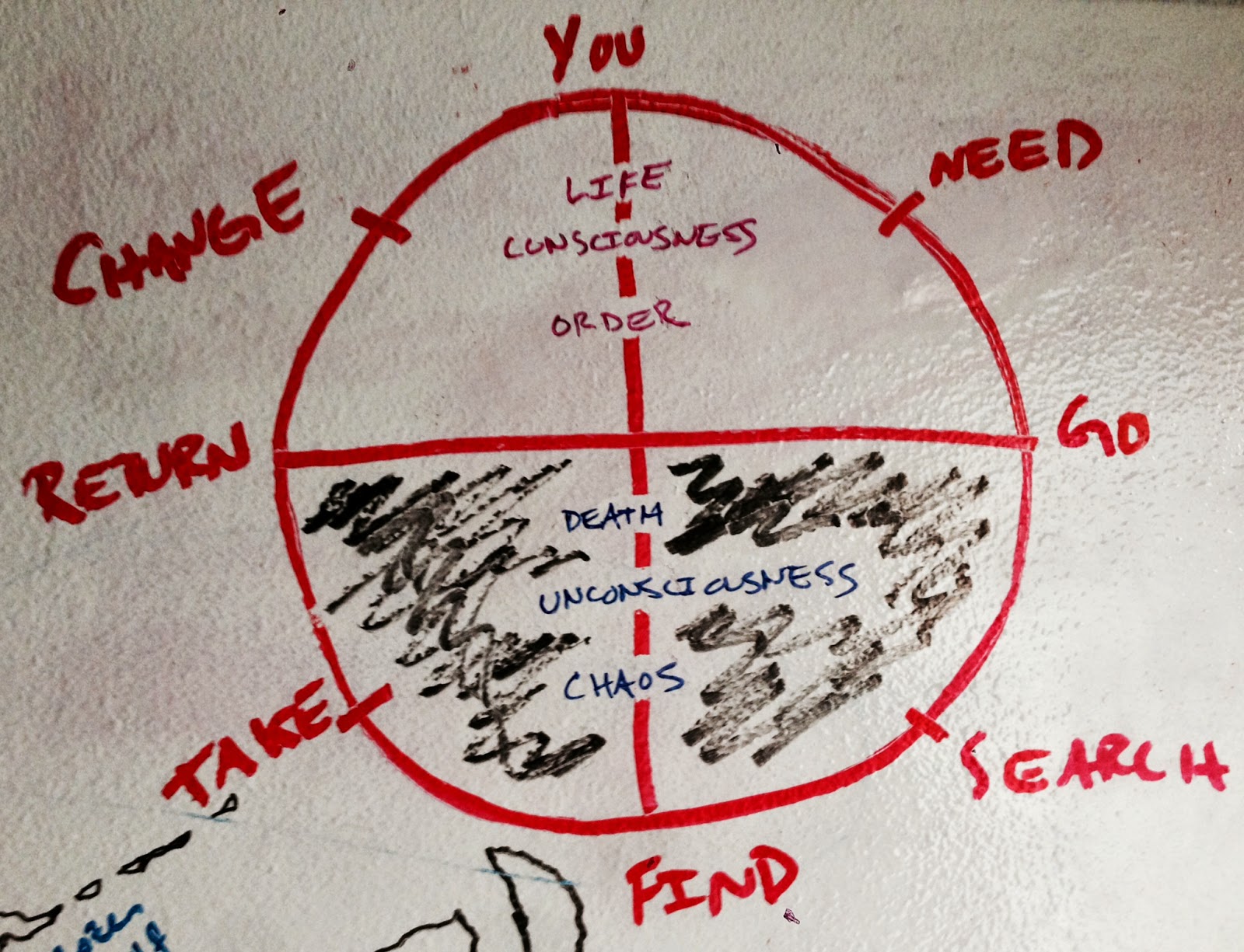
This is from my white-board wall, btw. Have I mentioned I have a
white-board wall? It's awesome.
So Harmon's basic idea is that you draw a circle, as demonstrated, with the following eight points around it:

  1. You
  2. Need
  3. Go
  4. Search
  5. Find
  6. Take
  7. Return
  8. Change

Ignore the stuff written in the middle of the circle; I may or may not go into more detail on that later (but Harmon does, so again, if you're interested, check out those websites above). For now I'm just going to focus on the eight plot points.

The story begins with you, a character who either is you (metaphorically or otherwise) or with which you can empathize, sympathize, or to which you can relate in just about any way. Said character then discovers they need (/want) something. S/he then goes to a location, condition, or set of circumstances that is unfamiliar to them (hence the shaded lower half of the circle--it represents the unknown, the un/subconscious, the dark basement where chaos reigns) and searches for the thing s/he needs, often by/through adapting to the new circumstances. S/he finds what was needed, and takes control of his/her destiny and pays the price for it. Then the character returns to the comfortable/familiar situation, having changed in significant, life-altering ways, after such a fashion that s/he now has mastery over the world in which s/he lives.

It's simple, it's elegant, and what perhaps hits home most of all for me is how much Harmon emphasizes the every-day-ness of it all--this basic journey is reflected in all narratives. The circular pattern of descent into chaos and return to order drives all stories; Harmon says to
Get used to the idea that stories follow that pattern, [...] diving and emerging. Demystify it. See it everywhere. Realize that it's hardwired into your nervous system, and trust that in a vacuum, raised by wolves, your stories would follow this pattern. ("Story Structure 101")
That, more than anything else, draws me to this method of structuring stories. Other methods, to me, seem a bit too focused on plot points and what-happens-where and get a little too specific for me. This, instead, simply teaches me what a story is, and then gives me the freedom to make what I want with it.

So, in the next couple weeks (months?), I'll be examining at least two (perhaps more) significant methods of story structure, but I'll use Harmon's formula as the lens through which to view them. I think it'll be interesting. If you do, too, come on back and check it out.


Sidenote: By the way, right now I'm watching Community (written by Dan Harmon). For the first time. So many friends have insisted I watch the show, and I've finally gotten a hold of the first few seasons. And okay folks, this show is DELIGHTFUL. It is brilliant and hilarious and uses all sorts of TV and film tropes in wonderfully curious ways. It's a little early to say for sure (I'm only a few episodes into season 2), but it may have already usurped my co-favorite sitcoms, Arrested Development and Seinfeld. It's that good. So, yeah, I might talk more about that one day, too.

Wednesday, January 23, 2013

Outlining and Story Structure

I'm a discovery writer, aka gardener, meaning I generally don't do a lot of outlining before I jump into writing.  I prefer to start with a situation and some characters, and then see where things go from there.

But that doesn't mean that outlining has no place in my writing process.

In my current project, for example (my novel [very] tentatively titled Before the Dark), I've already discovery written the first draft.  I didn't have an outline when I wrote it.  I had a vague idea of where I wanted things to end up, but even those ideas were blown out of the water by what actually ended up happening pretty organically.  But, now that I'm tackling the revisions and trying to produce a coherent second draft, I'm running into some difficulties.  Most of those difficulties are of an organizational nature.

So, I've turned to outlining after-the-fact.

This may seem completely backwards to many of you (and for many of you, it probably is--writing is relative, after all), but for me this technique often solves many of those organizational issues.  Getting my ideas out there, in the first draft, is often the easy part compared to organizing them into some sort of recognizable story in the second draft.  The same was true for me when writing academic papers as well, and I used this outlining technique often when I was in school, for research papers and short stories and even with some of my essays.

I was actually pretty resistant to using this technique this time around, though.  And, now that I think about it, I usually whine a bit or put up some sort of pathetic, pouty fight before succumbing to the idea.  A part of me still wants to believe in the purity of the muse, I think, and keep that dream alive.  But the pragmatist in me knows how silly that is, and knows how much more important hard work and tenacity are than what little inspiration my muse has ever really given me.

I'll admit, I've never outlined anything remotely this large before (my novel currently sits at 190k words).  I had to approach it a few different ways before I finally found a method that worked for me.  But when I finally found a method that worked, things really took off.

I'd heard the folks over at Writing Excuses* mention a 7-point outline before, but hadn't put much stock into it because, hey, I'm a discovery writer and should despise outlines by nature, right?  Wrong.  At least I was.  So I realized my transgression, repented, and took the 7-point story structure idea for a spin.

I've been very pleasantly surprised by the results.

A bit about the structure itself:  Dan Wells is the one who has sort of commercialized the form, it seems (although he admits he stole the idea from a role playing game manual ... O.o).  He has a brief explanation and a link to a great power point presentation here, and I'll also post the first video in a youtube series, in which he presents said outline, below.   All in all it's great stuff, but here's the basic structure of the outline:

  1. Hook - where things begin (usually the polar opposite of the Resolution)
  2. Plot Turn 1 - introduce conflict
  3. Pinch 1 - something goes wrong, bad guys attack, general peace is destroyed
  4. Midpoint - where character decided to start ACTing instead of REACTing
  5. Pinch 2 - apply more pressure:  a plan fails, mentor dies, bad guys seem to win, etc.
  6. Plot Turn 2 - the "final piece to the puzzle" of the character's struggle
  7. Resolution - where things are, well, resolved--it's what the story has been working towards the whole time!
I won't go into a lot of detail because Mr. Wells explains things much better than I could (check out the links if you want more info!  Seriously!).  It's pretty elementary stuff, and honestly it seemed a bit too rudimentary for me, to begin with (I don't know why I thought that, other than my own stupid pride).  But as I applied it to my story, things sort of just fell into place.

Of course, my whole novel doesn't boil down to one simple 7-point outline.  Each of my main characters actually has one 7-point outline to themselves, and some characters even have more than one outline addressing various conflicts.  So even though the form itself seems simple, things can get complicated pretty fast, which was good considering Before the Dark is much more complicated than I ever intended it to be.

The good news is that I'm pretty much finished with the outlining process at this point, and I feel pretty good about it.  I already feel much more direction and purpose regarding my revisions.  I'm excited to get back into the swing of things and make this thing into a real, cohesive novel.

I'm also a full advocate of the 7-point story structure form, now, which is something I never thought I'd be.  But there you go.  Something new every day!


*  A phenomenal podcast about writing.  If you're at all interested in the craft, you should check out a few episodes.


Saturday, July 03, 2010

on beginnings, and my own personal NaNoWriMo

So I'm back to work on my YA (young adult) novel--a project I started briefly in April on a whim, and then set it aside, as most of my time and energy was going into finishing The Rising.  I wanted to flesh the idea out enough that I wouldn't forget it, but put it aside to resume work on TR.

Things are going well.  I already had about 2.5k words done, and now I'm working on pushing that up, slow and steady.  At my high points while working on TR, I was writing 4-5k words/day.  I would love to get back into a groove like that with this YA project (as yet untitled), but I've forgotten one thing . . .

How FREAKING HARD BEGINNINGS ARE.

For the most part, I'm a discovery writer.  That means that, although I'll do some world-building and some very vague and sparse outlining, I really just start with an idea and run with it.  I generally have an idea of where I want things to end up, but more often than not that idea gets blown out of the water by other, bigger, better ideas as I'm writing.  Its a very organic process, and I love it.  But it also makes beginnings very difficult.  I can write a first chapter, no problem, but then I am strongly tempted to go back and revise that chapter, change it, make it better, or whatever.  Sometimes I even completely re-write the first chapter(s).  And then go back again and revise, change it, make it better, whatever.  And then rewrite them again . . .

It can be a very tedious and, more importantly, a futile process.  It doesn't get me anywhere.

So my biggest challenge in starting a new project is to just keep going.  I can't allow myself to go back and worry about whatever crap (and, for the most part, it is usually crap) that I write in the beginning.  I just have to persist and push myself forward until I start getting to the really good stuff (or, at least, the better-than-crap stuff).

Then, when I finish the whole project, I go back and start revisions.  (Anything [almost] can be fixed in post.)

Of course, I could dedicate an entire blog-post to my writing process and quirks--and perhaps I will--but right now I won't.  I just want to let everyone know that I am working on a new novel, and so far its going well.  I'm really excited about the crisis I have to start the thing out, and then, well . . . we'll see where it goes from there.

Also, in order to motivate me to press forward in the process and not worry too much about what I've already done (and, probably, screwed up), I'm declaring the month of July my own personal NaNoWriMo.  NaNoWriMo = National Novel Writing Month.  Its a challenge and/or contest held in November, where writers all over the US attempt to write (the first draft of) an entire novel in one month (here's the official website).  50,000 words is the general word count consensus, which aligns quite nicely with the word count goal I have for my YA project.

So . . . I'm taking the challenge!  50,000 words in a month!

Think I can do it?  Thats quite a few words to write in one month, if you aren't aware.  About 1.6k words/day (although I'm planning on writing only 5-6 days a week, so it closer to 2k/day for me).  Nothing I can't do, as I've demonstrated with TR, but I just have to get into the groove.

So here goes NaNoWriMo, July edition.  Wish me luck.